I admit that I enjoy horses - not riding them so much (although that is a blast), but watching and photographing them just being themselves. They are incredibly beautiful and intuitive individuals, they have no pretenses, and they don't spend much time trying to be something they're not. When's the last time you saw a horse trying to be a rabbit?
We two-leggeds have a lot that we can learn from them.
But I have a particular fascination with ancient and historic breeds or types of horses. I guess anyone who knows me well wouldn't be surprised by this. I love old stuff: ancient artwork, old buildings, ancient stonework, sighthounds, learning a "dead" language. It's partly a measure of endurance I guess - anything that survives the test of time wins a lot of points in my book. But it's also having that tangible connection to the past that interests me...that link to both the humans and animals that have come before us.
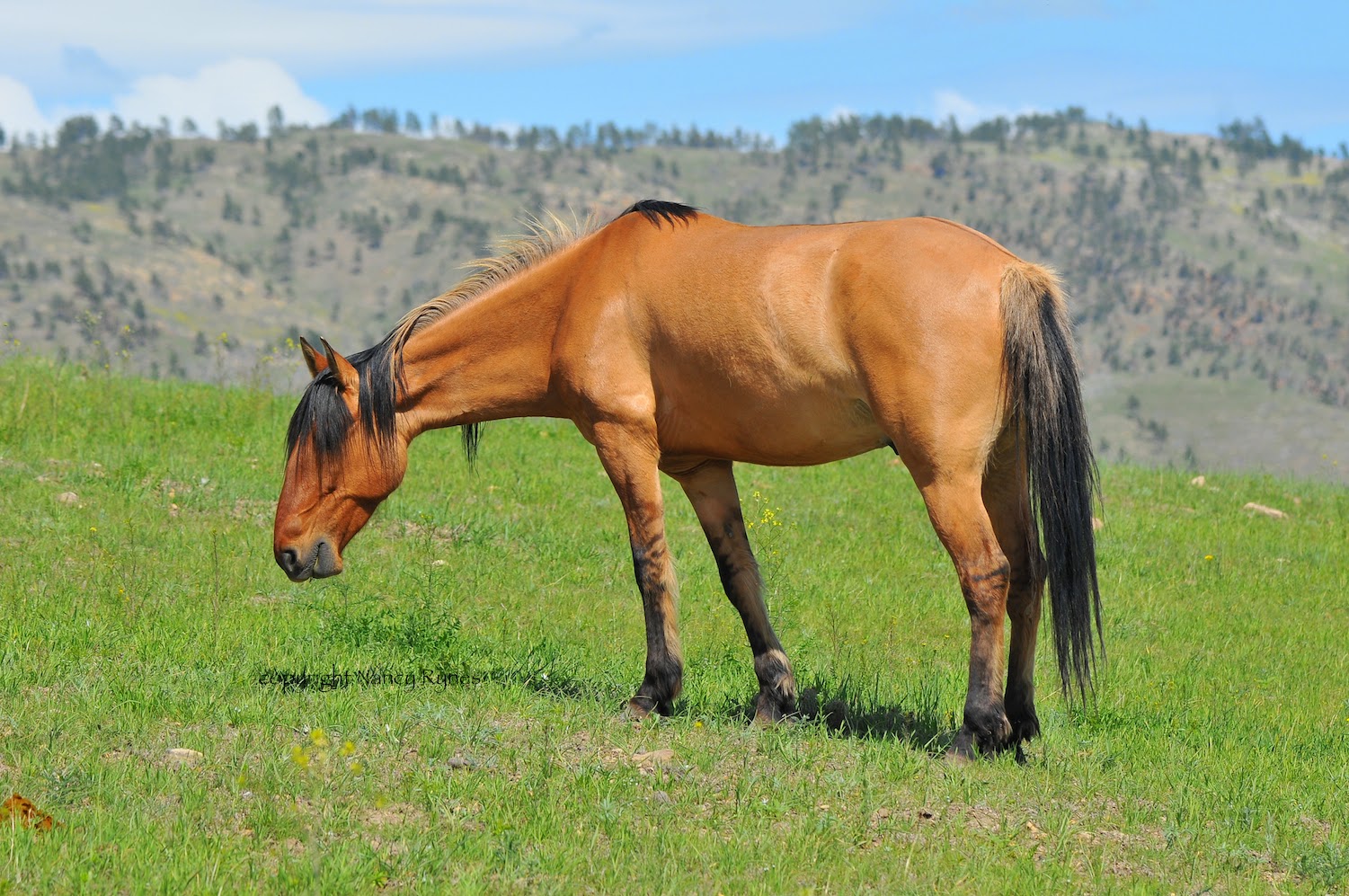
Spanish Mustang showing characteristics of the even older Sorraia horse (convex/Roman nose, two-tone mane and tail, dun coloring, and Zebra stripes on legs).
In the case of horses, the Spanish Mustang (or Spanish Colonial Horse) has long fascinated me. I won't go too in-depth with their history - this has been covered more thoroughly by
other writers, most notably John Hockensmith. John's book on Spanish Mustangs is well worth the read - the photos are beautiful, the content is well-researched, and the poetry magical.
But to get you started, the Spanish Mustang that we know here in America is a breed of horse that is closely descended from those brought to the "New World" by Spanish conquistadors and colonists. While horses had evolved on the North American continent and spread over a land bridge to Europe and Asia, but by about 10,000 BCE they were extinct here.
The Spanish re-introduced the horse to the Americas beginning in 1493. These Spanish Colonial horses came from several very ancient breeds or types native to Spain, the Iberian Peninsula, and other parts of Europe (and now mostly or completely extinct there), including those types known as
Sorraias, Tarpans, and Jennets. Some of their ancestors may even be depicted in the very old cave paintings of modern France and Spain.
Today's Spanish Mustang in large part descends from these ancient horses.
Spanish Mustang showing primitive coloration (dun coloring and Zebra stripes on legs).
The Spanish Mustang is distinct from the "American Mustangs" you've heard so much about. While some Spanish Mustangs can still be found roaming free in the American west, most of the wild or feral horses you see today are more correctly known as American Mustangs. The typical American Mustang is a mix of many different breeds of horse, including those Spanish Colonial horses, Paso Finos, Morgans, Andalusians, Thoroughbreds, Quarter Horses, and many other European, Asian, and American breeds. They're sort of the mutts of the equine world (and I say that with much love and respect).
"Wild Heart" - oil painting of an American Mustang.
But for me, the Spanish Mustang is a hardy, sturdy, and independent breed whose bloodlines have withstood the centuries. It symbolizes hardiness, adaptability, endurance, and independence.
I recently had an amazing opportunity to mingle with a group of
Spanish Mustangs at the Black Hills Wild Horse Sanctuary in Hot Springs, South Dakota. I stood among them, rubbed their noses, observed, and photographed them in a setting reminiscent of some of the lands their ancestors traveled.
While I was fascinated with their long history, at first there was a part of me that didn't want to like them so much. Weird, huh? But if you think about it, the ancestors of these horses were one of Spain's "weapons of mass destruction" back in the 16th and 17 centuries. Without sturdy horses, Spain would not have been able to wage such a brutal war on the Native People of this land, some of whom were my ancestors.
So I had mixed emotions when several came up to me wanting their noses rubbed.
But the Colonial Horses didn't ask to be used as weapons - they were simply a means to an end for the Conquistadors. They were what they were - horses serving masters that they had little control over. As soon as the Spanish Colonial Horses got the opportunity, many of them bolted from captivity and became almost-wild again in the wide open spaces of the American West. It was these escaped Spanish Mustangs who were the founding stock of today's "Wild Horse" (American Mustang) of the western US.
And no one can deny that the Native Americans themselves made full use of the descendents of these horses a century or two after the Spanish arrived.
Besides, how could you not love a face like this? When I rubbed the noses of these friendly equines, I realized that I was touching living, breathing history. Some of these horses' ancestors may be depicted in the ancient cave paintings of Europe, 20,000 to 30,000 years old.
Tater Tot - very friendly and just wanted attention from her two-legged visitors. Because, after all, we WERE there just to see her, right?
So I began to observe them for what they were: a band of horses just being themselves.
A band of Spanish Mustangs in the Black Hills of South Dakota.
Most were quite friendly, although some were standoffish.
I saw a definite pecking order: a few were very bossy, pushy, and dominant. Others were docile and easily bullied. Most were somewhere in the middle of these two extremes....very much like humans and our social maneuvering and office politics!
The grulla (gray) girls - a clique of gray Spanish Mustangs who are on the dominant side and have a bit of an attitude.
And, like humans, I also saw friendships and even "cliques" within the larger group. Woe to the outsider who tried to break in to an existing club!
Three of the older ladies stick together in a friendly grouping.
Some were quiet and low energy, others seemed to always be looking for trouble or stirring up the group. A few just wanted to run:
But none tried to be something they weren't. They seemed to be loving life as themselves, enjoying the freedom of hundreds of acres to roam. And while they may carry ancient bloodlines, it doesn't change who they are from day-to-day: beautiful, strong, spirited, independent animals who simply want to live the life they were born to live.
I can definitely learn a lot from them...
Note: While a few bands of Spanish Mustangs can still be found running free on BLM lands in the American West, most are now found in private hands throughout North America and Europe. If you look closely, though, horses with strong Spanish features can be found among the existing herds of American Mustangs on BLM lands.
If you'd like to experience Spanish Mustangs for yourself, visit the Black Hills Wild Horse Sanctuary in Hot Springs, South Dakota. At over 10,000 acres and 500+ horses, you'll see more mustangs in one place than your mind can comprehend. See www.WildMustangs.com for more information on hours, visiting, and tours.